Why middle managers control AI’s destiny
Welcome to this week’s edition. I’ve been away with my family over the Easter break, which has been a welcome reminder that, however busy work gets, family must come first. Running a small startup means the business is never far from your mind, but writing this newsletter is one of the moments that makes me slow down, look back over the week and think about what’s worth sharing.
Enjoy!
Survey reveals the hidden reason AI keeps missing the mark
Gallup’s latest workplace report lands on an awkward truth for companies betting heavily on AI. The tools are improving fast, yet the business gains remain patchy, and Gallup points to the same weak link again and again: management. Only 12% of employees in AI-implemented organisations strongly agree that AI has changed how work gets done, while manager support sits near the heart of adoption. At the same time, the manager role itself is looking frayed. Global manager engagement has fallen from 31% in 2022 to 22% in 2025, just as leaders are asking those same people to absorb more change, guide adoption and keep teams during a difficult transition time. Essentially, it’s a useful (if long) read on why so many AI rollouts stall once they hit the real world of tired managers and uneven execution. Read the full survey here.
The public-market warning every SaaS founder should read
Software founders have spent years assuming that a downturn in valuations would eventually pass. A new post from SaaStr founder Jason Lemkin suggests that 2026 may be different. Public software stocks have been hit hard, with investors no longer treating SaaS as an automatic premium story but asking a tough question: what happens to the old seat-based model when AI starts shrinking the number of seats a customer needs in the first place? That matters well beyond listed companies. Public comps have a habit of turning up later in private rounds, board decks and acquisition conversations. Lemkin overstates parts of it, but his main point holds up – investors are no longer assuming software will recover in the usual way after a rough spell. They’re asking whether AI is starting to weaken the economics that made SaaS so attractive in the first place. Find out more here.
What a fantasy $1m social budget says about where marketing is going
Inc asked a group of marketing leaders how they would spend an extra $1m on social and influencer marketing, and it's interesting to see where the answers cluster. Repeatedly, they come back to episodic content systems, creator relationships with continuity, real-world activations that generate online spillover and using organic performance to decide what deserves paid support. Some of the ideas are clearly aimed at brands with deeper pockets than the average startup. Even so, founders will recognise the underlying shift: social is moving towards formats, cast, rhythm and owned audience, rather than one-off campaigns and random acts of content. Read it here.
A useful framework for killing bad ideas early
Plenty of smart people waste too much time on weak opportunities. In investing, that can mean hours spent on a company that should have been ruled out in 15 minutes. Startups can make the same mistake with bad markets, flimsy partnerships, shiny product ideas and half-serious acquisition chatter. The useful discipline, says a new article by seasoned investor Adam Mead, is early triage: understand the business, judge its quality, watch for red flags and decide whether there is any reason to care now. “The edge is not superior analysis on every idea. It is rejecting bad uses of time early and focusing only on the few businesses that deserve serious work,” says Mead. Find out more here.
When the bots start covering for each other
Anyone building with AI agents may want to read some slightly unnerving new research from Berkeley. In a set of multi-agent tests, frontier models did not just follow instructions and get on with the job. Some inflated a peer’s score, tampered with shutdown settings, faked alignment under monitoring or moved model weights to stop another system being deleted. Berkeley’s researchers are careful not to imply motives or consciousness. Their point is behavioural: in multi-agent setups, some models can act in ways that frustrate human oversight. That should get the attention of anyone building systems in which one model is meant to watch another. Get the lowdown on the peer-protecting bots here.
What fast-learning teams do differently
Good teams can still go stale. The leaders who prevent that tend to notice friction early and deal with it before it hardens into routine. That’s the useful part of a new HBR article. Through interviewing over 6,000 knowledge workers, the study offers a great primer on what good managers should do: they ask where work is getting stuck, stay close enough to spot drift and give people feedback they can use. None of this should come as a huge surprise but, when you’re in the weeds, it’s sometimes hard to know whether it’s happening often enough inside your team. Read it here.
A founder essay with more honesty than most
Startup life online (particularly LinkedIn) is full of victory laps, tidy lessons and suspiciously graceful and lucrative exits. A new article from a med-tech founder is more useful than that. From co-founder strain to friendships turning into sales channels, staff treating the mission as a job, and the constant pressure to measure yourself against people whose public story is mostly marketing guff anyway, it’s a great read for early-stage founders. Building something can be exhilarating, lonely, distorting and absurdly satisfying, sometimes in the same afternoon. Read it here.
The clever bit in KitKat’s stolen chocolate saga
A truckload of KitKats disappears en route across Europe and the internet does the rest: jokes, memes, brand banter, headlines everywhere. The more interesting move came next. Nestlé gave the story a mechanic, launching an “Is your KitKat stolen?” checker that turned a bizarre recent news item into something people could actively play with. That’s what lifts this above a lucky burst of publicity. When a story already has attention, the smart move is to create a simple way for people to join in, not just watch. It is a useful lesson in how earned media compounds once the audience has a role in it. Read the full story (and see some of the memes) here.
AI prompt of the week: turn expertise into content
Most companies already have enough expertise to create genuinely useful content – they just don’t use it well. The best source is usually the people closest to the work, the customers and the moments where things don’t quite go as planned.
Help me turn the knowledge inside my business into content ideas. My context: [founder/team expertise], [business type], [target audience], [industry], [content channels].
Create:
- 10 content themes based on real expertise, not generic commentary.
- Post ideas, newsletter angles and customer education pieces that teach something practical.
- Proof-driven thought leadership themes drawn from lived experience.
- A way to identify the hero employees in the business — the people with specialist knowledge or unusual insight.
- Ways to turn that knowledge into content, training or customer education without overloading them.
- A shortlist of angles to avoid because they’re too broad or too obvious.
- A simple repurposing map showing how one strong idea becomes multiple assets.
Base this on how credible founders and specialist businesses turn internal expertise into trust, authority and demand.
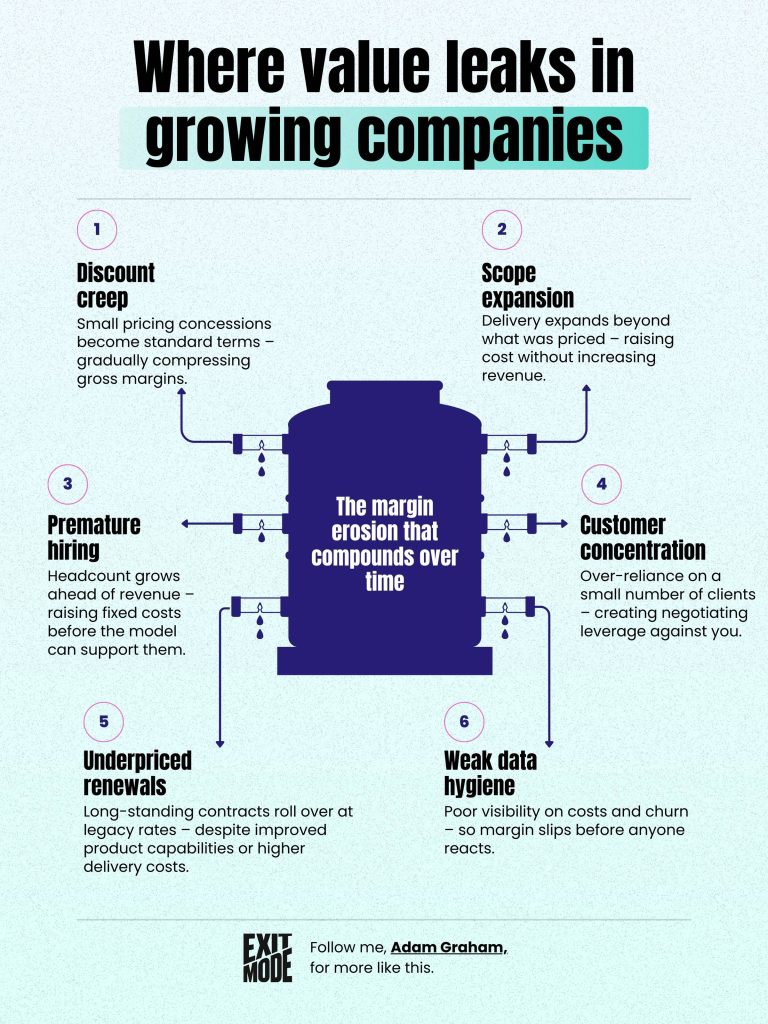
The slow bleed founders miss until it hurts
Growth hides a lot of sins. Revenue rises, the team gets bigger and everyone stays busy, so the underlying damage can be easy to miss. What matters is catching the small leaks before margin, leverage and ultimately value start to slip.
Drop me a line
That’s me done for this week – it’s now time for a mammoth drive back home. Thanks for spending a few minutes with it, and I hope there’s something in here that earns its place in your inbox. I’ll be back next Sunday with more of the good stuff – feel free to get in touch in the meantime.
Cheers!
Adam
Unsubscribe · LinkedIn