When foreign capital comes calling
Hi there
Before you head out and enjoy what is shaping up to be a glorious bank holiday Sunday, here are a few nuggets to stimulate the mind. Britain is mid-way through its biggest dealmaking year in over a decade, OpenAI has just bought equity in an entire YC cohort with tokens instead of cash, and AI is reshaping who sits in the middle of an organisation. There is a thread running through all of it about who gets to decide the shape of your company next.
Enjoy!
Britain is mid-way through its biggest M&A year in over a decade
Foreign takeovers of UK companies have surged through 2026 with inward M&A reaching multi-year highs and London-listed names from KKR’s £4.8bn buy of Spectris to Doordash’s £2.9bn takeover of Deliveroo setting the tone. US private equity and Asian strategics are doing most of the chasing, and the consistent commentary from City advisers is that UK assets are trading at a discount to comparable US peers. The signal for SME owners is simple. When the top of the market trades at these multiples, the appetite filters down. Buyers who could not get a look at the FTSE 100 names start looking at the next tier, and the tier below that. If you have ever thought “in a few years”, a few years just got shorter. Read the article here.
Sam Altman’s mic drop offer to every YC startup
At a Y Combinator event on Tuesday, Sam Altman offered $2 million of OpenAI tokens to every one of the ~169 startups in the current Spring 2026 batch, in exchange for an uncapped SAFE. Not cash. Tokens. The structure means OpenAI converts into equity at the next priced round, with no valuation cap, so founders effectively pay in future dilution rather than current ownership. The bigger story is what it does to competitive moats. OpenAI is now both supplier and shareholder for an entire cohort of AI-native companies, and the incentive to build on its platform compounds with every round those startups raise. For SME owners outside the Valley the takeaway is uncomfortable but useful. When your biggest platform supplier is also your potential investor, your potential competitor, and your potential acquirer, the supplier-relationship question stops being a procurement decision and becomes a strategic one. Worth thinking about before you sign the next enterprise contract. Read the article here.
What Deloitte’s Gen Z and millennial survey tells you about the next ten years of hiring
Deloitte’s 2026 global survey of 22,500 Gen Zs and millennials lands on a counter-intuitive finding. The generations that have spent a decade being framed as restless and ambitious are now prioritising stability, skill-building and well-being over fast growth. Money still matters, but the willingness to put up with a bad manager or a punishing schedule for a stretch role has collapsed. For SME owners this is mostly good news. It widens the gap between firms that can offer real autonomy, learning and a calmer cadence and the corporates that cannot. The cost of being a thoughtful employer is going down and the return is going up. Find out more here.
The AI manager purge is real and it is moving fast
The Guardian’s reporting this week pulls together a pattern that has been visible for months. Snap is cutting 1,000 jobs into smaller AI-powered squads. Coinbase, Meta, Block and Atlassian are all on record about thinning the middle layer. Meta confirmed 8,000 layoffs on Wednesday and reassigned another 7,000 staff. The roles going are the ones that mostly coordinated, summarised, or reported upward, which is exactly what current AI tools do for free. The takeaway for SMEs is not to copy the playbook. It is to look at your own org chart and ask which roles produce decisions and which roles only produce traffic. The first kind are still hard to replace. The second are about to get cheaper. Read the article here.
Gallup’s $10 trillion engagement number is worth taking seriously
Gallup’s State of the Global Workplace 2026 report puts engaged employees at 20 per cent worldwide, down from 23 per cent two years ago, and pegs the lost productivity at around $10 trillion a year. The drop is sharper among managers than individual contributors, which lines up with everything else happening in the labour market this year. The useful frame is not the headline number, it is the cost of doing nothing. If your engagement score is mid-pack, the cheap interventions (clear priorities, manager training, regular one-to-ones) still produce single-digit-percent productivity gains. Few capital projects pay back as quickly. Read the article here.
Canva’s data on AI and consumer trust is a useful gut check
Canva’s marketing study this week argues that consumers are not as anti-AI as the noisy debate suggests, but they are exacting about how it is used. The top trust drivers are data protection (53 per cent), disclosure of AI use (52 per cent), and a guarantee that AI is not replacing jobs (39 per cent). For SME brands the practical point is that being open about where AI shows up in your business is now a brand asset, not a confession. The brands that say nothing get tarred with the worst assumptions. The ones that show their working get the benefit of the doubt. Read the article here.
When Shein buys Everlane for $100m, that is the end of a brand era
Fast fashion’s most controversial player has reportedly agreed to acquire Everlane, the radical-transparency darling, in a deal that values the business at $100 million and reportedly leaves common shareholders with nothing. Everlane raised at multiples of that figure during the DTC boom. The bigger story is that the entire direct-to-consumer mid-market is now in distressed-sale territory, with brands that built on Instagram economics being acquired for parts. The lesson for any owner building a direct brand is that distribution is not strategy. A community is not a moat. The brands that survive the next five years will be the ones with channel economics that work without paid social subsidising them. Read the article here.
Workday says UK businesses are building a “copy/paste economy”
A Workday study published this week warns that disconnected AI tools are creating what they call a “copy/paste economy”, where employees spend hours moving outputs between systems instead of actually benefiting from automation. The data is striking. The average UK knowledge worker now uses three or four AI tools that do not talk to each other, and the time spent stitching them together has erased most of the productivity gain. For SME owners this is a useful warning before you sign three more SaaS contracts. The next round of AI value will come from integration, not from adding another shiny tool to the stack. Find out more here.
AI prompt of the week: pressure-testing your management layer
A useful exercise this week, given the layer-thinning happening across the tech majors. Pick the three most senior people who sit between you and the front line of the work. For each, list their title, what they own, what they actually spend the week on, and three recent decisions or outputs of theirs that you can name. Then paste it into the prompt below and read the answers slowly. Most owners discover at least one role that has slowly turned into coordination work dressed up as management, and at least one role that could carry twice as much weight if it was rewired.
You are an experienced operating partner reviewing the management layer of an SME. I will paste a description of three managers in my business, including their title, what they own, what they spend their week on, and three recent examples of decisions or outputs they produced. For each, I want you to assess: 1) the strategic value of what they produce on a scale of 1-10, 2) whether the role could be reshaped to remove coordination work and add decision work, 3) one concrete experiment I could run in the next 60 days to test whether the role is being used at its full leverage. Be direct. If a role looks like coordination dressed up as management, say so plainly. Do not soften the language. End with a single sentence on whether my management layer is investing in growth or insuring against my own absence.
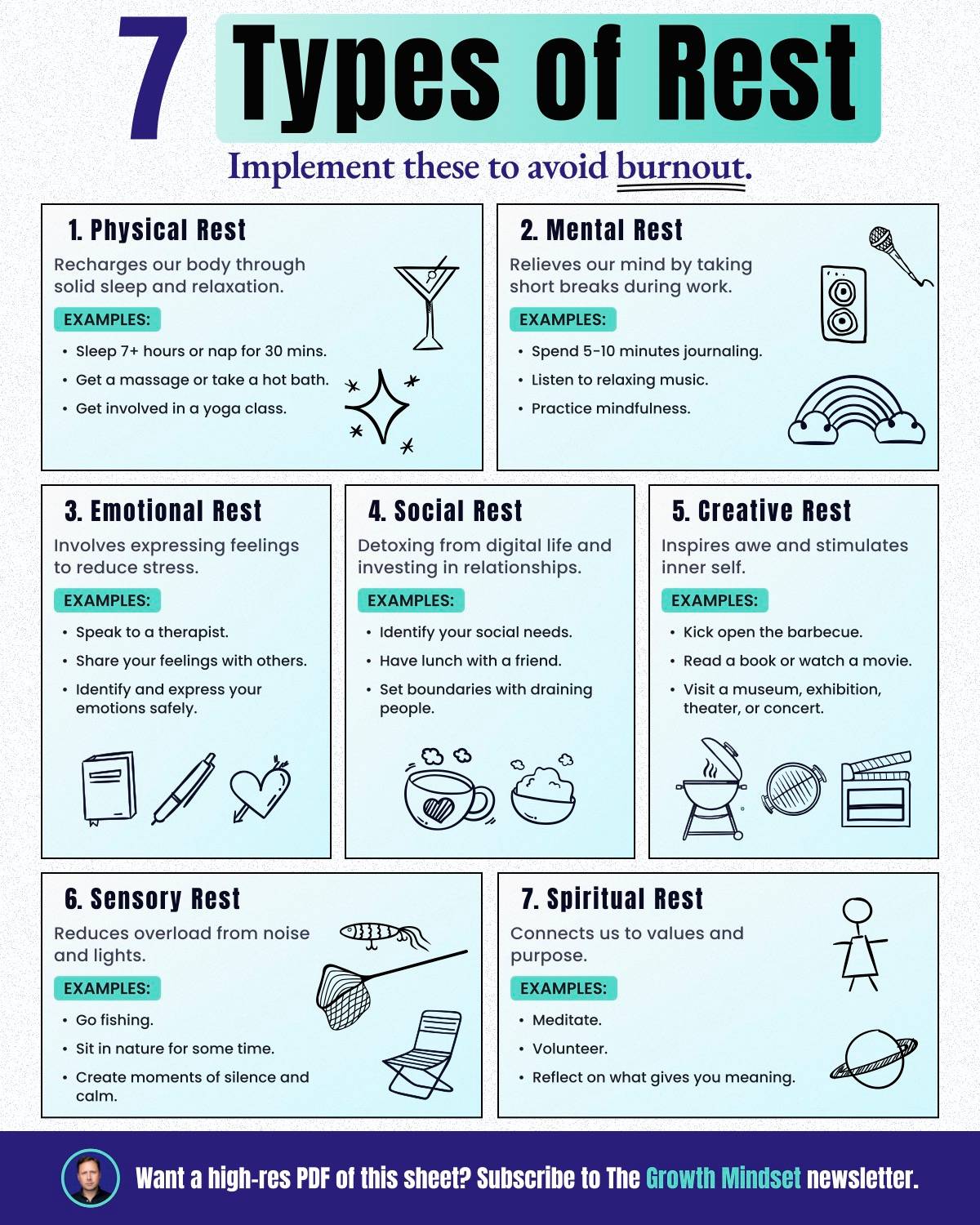
Seven kinds of rest worth taking this bank holiday
A bank holiday is the right week to remind yourself that rest is not one thing. The infographic below maps the seven categories: physical, mental, emotional, social, creative, sensory and spiritual. Most owners I speak to are good at one or two and running on empty in the others. If you have already booked a long lie-in but you are still scrolling work email from the sofa, that is physical rest without mental rest, and you will not feel restored on Tuesday. Pick the two on the list that you are most depleted in this week, and put one practical thing for each into your calendar before Tuesday morning. The owners who run for decades treat this as maintenance, not indulgence.
Drop me a line
If a line in here landed, or if you are wrestling with the right pace of selling, hiring, or letting go this quarter, hit reply and tell me. I read every one. And if a friend or colleague would get something out of this, the easiest favour you can do me is to forward it on.
Cheers!
Adam