The businesses buyers come looking for
Hi there
I have been chewing on one idea this week: the best businesses rarely get sold, they get bought. Boots was not on the market, and yet buyers turned up with ten billion dollars anyway. That difference, between chasing a buyer and being found by one, runs through everything in this issue.
Enjoy!
Boots shows the strongest position is being bought, not sold
Sycamore Partners only completed its purchase of Boots last year, with a London float pencilled in as the exit. Instead, the Weston family and Australia’s Sigma Healthcare have turned up at the door, and early talks now value the chemist at around 10 billion dollars. No sale process, no roadshow, just inbound interest in a 177-year-old business with unmatched high-street presence. That is the position every owner should aim for: an asset so obviously valuable that buyers start the conversation. When they come to you, you set the terms. Read the article here.
Gary Lineker’s podcast bet is really a lesson in focus
Goalhanger, the production company behind The Rest Is History and its siblings, has been named Britain’s fastest-growing private company, with sales of £37.9m in 2025 and average annual growth of 321 per cent over three years. The interesting part is what they did not do. No sprawling slate, no chasing every format, just one repeatable model (smart people talking about subjects they love) executed brilliantly and franchised carefully. Most owners dilute their winners by adding adjacent bets too early. Goalhanger scaled by doing more of the same thing, better. Tight focus is still the fastest route to value. Get the story here.
Victoria’s Secret is proof that brands rarely die, they get mismanaged
Two years ago Victoria’s Secret looked like a cautionary tale. This month it reported first-quarter sales up 15 per cent to 1.56 billion dollars, raised full-year guidance past 7 billion, and saw shareholders re-elect the entire board against an activist challenge. The turnaround did not come from a clever rebrand alone. It came from fixing product, tightening operations and letting the brand mean something again. For owners, the read-across is encouraging: customer affection outlives bad strategy. If your brand has drifted, the equity is usually still there waiting to be recovered. Read more here.
AI is now the official reason companies give for cutting jobs
For the first time, AI was the most-cited reason for US job cuts in a single month: 38,579 of May’s 97,006 announced redundancies, roughly 40 per cent, according to Challenger, Gray & Christmas. The 2026 total attributed to AI already exceeds the whole of 2025. Whatever you believe about the underlying truth (some of this is cover for ordinary cost-cutting), the social licence to restructure around AI has clearly arrived. For SME owners the question is sharper: if your larger competitors are rebuilding their cost base, standing still on this is itself a decision. Read the article here.
Who actually thrives in a hybrid human-AI workforce
The New York Times convened a panel of labour economists and technologists to ask who wins as AI seeps into every role. Their answer is unfashionably human: judgement, taste, relationships and the ability to frame problems matter more as execution gets cheaper. The people most at risk are not juniors, but mid-level workers whose value was coordinating work that machines now coordinate. For owners building teams, that reshapes hiring: recruit for the things AI makes scarcer, not the things it makes abundant. Read the piece here (paywalled, Archive).
Remote work is popular and lonely at the same time
New research covered by NPR finds that fully remote workers report more isolation, anxiety and sadness than their in-office peers, even though most of them still prefer working from home. The researchers’ conclusion is not a return-to-office mandate; forced commutes solve nothing. It is that connection has to be designed in deliberately: real reasons to gather, proper onboarding, managers who notice withdrawal early. For smaller firms this is a genuine edge. You can build belonging at a scale corporates cannot, if you treat it as part of the operating model rather than a perk. Find out more here.
Microsoft’s price rise is a masterclass in pricing power
From 1 July, Microsoft 365 business plans go up across the board, with some tiers rising more than 15 per cent. Customers will grumble, very few will leave, and Microsoft knows it. That is what a repeatable revenue engine looks like: a product so embedded in daily workflows that switching costs dwarf the increase. Two prompts for owners. First, audit your own software estate before the deadline; locking in renewals now saves real money. Second, ask what would have to be true for your customers to absorb an 8 per cent rise without blinking. Read more here.
EE’s World Cup ad proves bravery still beats the category template
World Cup advertising is a sea of celebrity cameos and montages. EE took a different route: a campaign aimed at young men, about having something to strive for, that moved The Drum’s resident effectiveness columnist (a man who does not even like football) to tears. The lesson is not “make people cry”. It is that distinctive emotional territory, claimed with conviction, beats outspending rivals on the same clichés. Small brands cannot outbid the giants during big cultural moments, but they can out-feel them. Read the article here.
AI prompt of the week: the buyer’s-eye audit
Most owners only discover how a buyer sees their business when diligence starts, which is the most expensive possible moment to learn. This prompt forces the outside view early. Run it with your accounts summary, org chart and customer concentration figures to hand, and be honest with the inputs; the output is only as good as what you feed it.
“Act as an experienced acquirer evaluating my business for purchase. I will describe the business: [sector, revenue, profit, growth rate, team size, my role day to day, top five customers as a percentage of revenue, recurring versus one-off revenue split, and how leads arrive]. First, score the business from a buyer’s perspective on six dimensions: founder independence, repeatability of revenue, margin stability, customer concentration, quality of reporting, and evidence of inbound interest. Be blunt about weaknesses; do not soften the assessment. Second, identify the three findings most likely to reduce your offer or kill the deal entirely, and explain the reasoning as a buyer would in an investment committee memo. Third, give me a prioritised 12-month plan to fix the weakest two dimensions, with specific actions per quarter and the evidence a future buyer would want to see for each. Finish with the single question you, as a buyer, would ask me in the first meeting that I am least prepared to answer.”
Run it annually. The gap between your score and your self-image is the work.
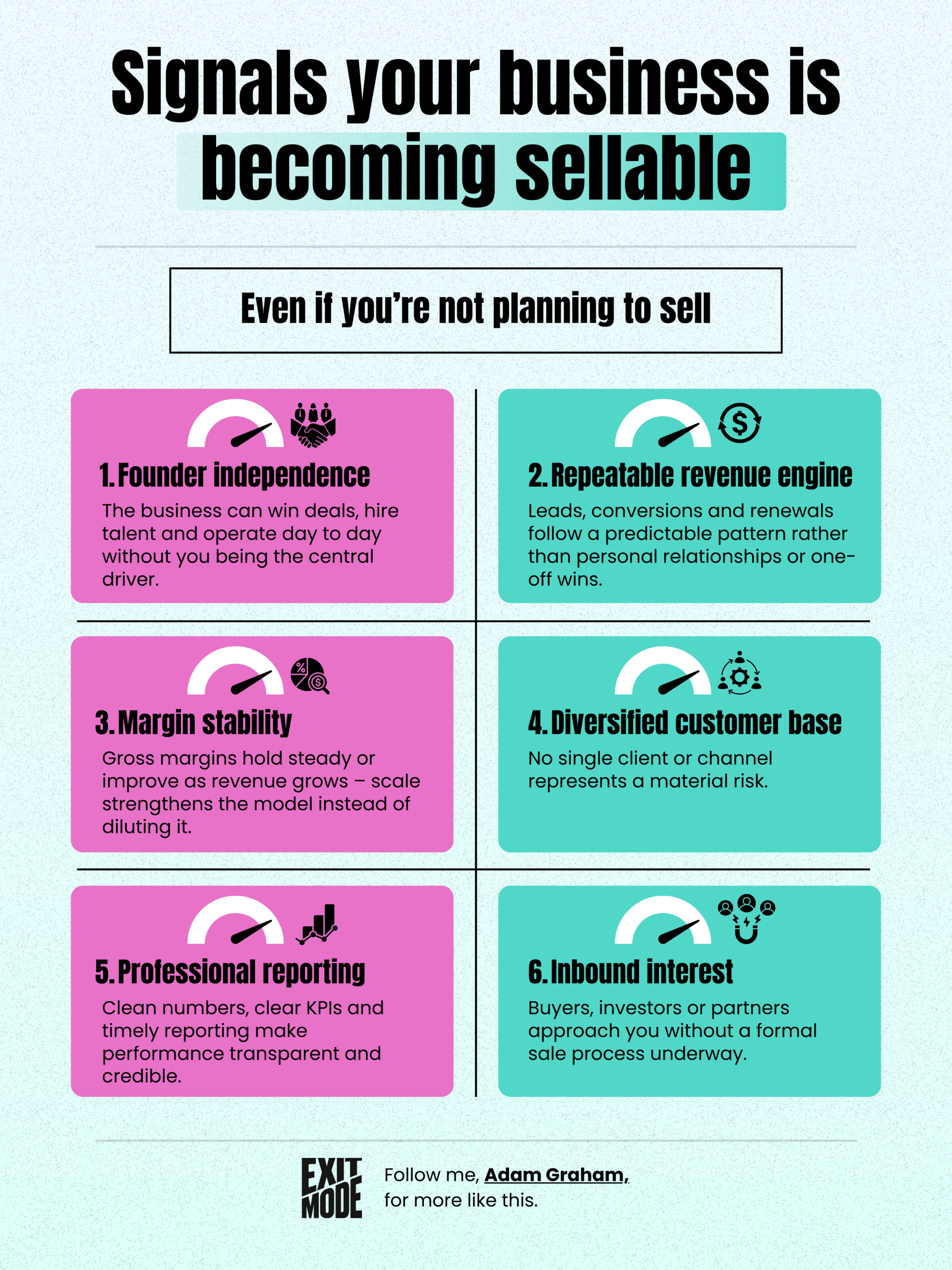
The six signals a business is becoming sellable
This week’s framework sits behind the Boots story. Buyers rarely appear by accident; they appear when a business starts giving off signals. The infographic below sets out six of them: founder independence (the business wins deals and hires talent without you as the central driver), a repeatable revenue engine, margin stability as you scale, a diversified customer base, professional reporting, and the clearest signal of all, inbound interest, when buyers, investors or partners approach you without a formal process underway. The subtitle matters most: even if you are not planning to sell. These are simply the markers of a well-built company. Score yourself honestly against all six, then work on the weakest one first.
Drop me a line
Has a buyer, investor or competitor ever approached you out of the blue? I would love to hear what prompted it, and what you did next. Hit reply and tell me; I read every response, and the best stories often shape future issues.
Cheers!
Adam