The hidden cost of too many meetings

Welcome to The Growth Mindset. There’s no grand unifying theory this week, just a decent pile of things that caught my eye, made me think or briefly made me mutter “hmm, that’s interesting” to nobody in particular. Which, on balance, is probably as good a reason as any to send a newsletter.
Enjoy!
The modern company’s meeting habit is eating the working week
A lively Times article looks at the strange lengths companies are going to in order to make meetings shorter and less wasteful – from consultants giving updates while in the ‘plank’ position to software that scores participants for focus and boredom in real time. It’s a funny, well written piece with a serious message. Too many businesses now spend huge chunks of the week in meetings that drain time, energy and salary cost without moving much forward. It’s a useful prompt to ask whether meetings in your company are helping people decide and act or simply creating the feeling of activity. While AI may help with notes and summaries, it won’t fix a culture hooked on unnecessary gatherings. Read it here (paywalled so access through Archive).
When a failed brand decides it’s an AI company
Allbirds’ attempted reinvention as NewBird AI has attracted plenty of mockery, and on one level it deserves it: a struggling trainer brand buying GPUs is exactly the sort of thing that makes markets look unserious. But a new Atlantic article is worth your time because it treats the move more seriously than most online hot takes have. The interesting question is not whether this specific pivot works, but what it says about the current market: AI is now such a magnet for capital, narrative and speculation that even a near-empty shell company can try to pivot with it. For founders, that makes this a useful read on where opportunism ends, where reinvention begins and how distorted pricing gets when investors are desperate to find the next AI winner. Read it here.
Why the sales funnel keeps surviving every marketing revolution
A new piece in Adweek pushes back against one of marketing’s favourite bad habits: announcing the death of an old framework simply because a new technology has arrived. The argument is that the sales funnel – beloved methodology of marketing strategists for decades – still matters. Not as a neat description of how any one customer behaves, but as a way of diagnosing where a market is and what a brand needs to do next. That is useful far beyond marketing departments. AI may change execution and platforms will keep inventing new ways to package the journey, but none of that removes the need for clear objectives, sensible sequencing and a grip on what could be blocking growth. Find out more here.
AI editing may be changing meaning, not just wording
When AI “helps” with writing, is it only improving expression, or is it also nudging the substance? That’s the question posed in a new research paper which found that heavier LLM use was linked to a rise in bland, less opinionated content, and even grammar-focused revision prompts produced semantic shifts rather than merely cleaner sentences. Anyone relying on AI to polish strategy docs, investor updates, applications or internal reviews should think harder about whether the tool is making the thinking clearer or just making it more boring. Read it here.
Why Reddit keeps getting more useful
I’ve written before in this newsletter about Reddit’s value as a research tool, and a new GQ piece helps outline why. As the internet fills up with over-polished content and AI-generated sludge, Reddit has become more useful because it still feels messy, human and practical. The point the writer makes is that, despite some flaws, Reddit is a live archive of lived experience – full of people who can help users research products, pressure-test a decision, diagnose a niche problem or get an explainer on almost any subject in the world. As the piece concludes: “Turns out a stranger with nothing to gain might be one of the most powerful things on the internet.”. Find out more here.
Flexible work is starting to swallow the day
A report from Owl Labs highlights the rise of what it calls “microshifting” – breaking work into shorter, non-linear bursts around energy levels, life admin and other responsibilities. On paper, that sounds like autonomy. In practice, it can also mean the working day starts leaking into every available gap, especially when people feel pressure to stay responsive across teams and time zones. Companies need to olearn how to stop flexibility turning into permanent low-level availability, it says, and leaders who want the upside will need to get much clearer about boundaries and response times. Get the report here.
Why one company built an AI agent to answer RFPs
A fascinating LinkedIn post I spotted this week reveals how one executive built an internal AI tool to help draft RFP responses from thousands of company documents – case studies, pitch decks, delivery records and all the other material bid teams usually have to dig out by hand. What makes it particularly interesting is that most of the challenges came from bad folders, bad labels, duplicate files and unreliable source material rather than the model itself. Anyone who spends too much time pulling together RFPs will recognise the problem immediately. The encouraging part is that the tool did become useful – but only once the company treated it as a knowledge and evidence challenge, not just an AI one. Find out more here.
The backlash against brand purpose has a data problem
Back in 2019, it became fashionable – if not essential – for a brand to have a purpose and mission, usually tied to ESG or CSR commitments. Then came a backlash which saw a lot of organisations dialling back those initiatives. A new essay in The Drum argues that the evidence used to discredit brand purpose is often no stronger than the evidence that once made it crucial. The author points out that marketers have a habit of turning a messy strategic question into a false binary, then using selective data as proof that the matter is settled. Ultimately, few would disagree that brands should try and do some good for society where they can and, as the piece says, brand purpose “should remain innocent until proven guilty”. Read the article here.
AI prompt of the week: customer retention plan
Most churn looks obvious only after it’s happened. The way forward is spotting the reasons customers start drifting before they disappear altogether.
Help me analyse why customers are churning or disengaging. My context: [business type], [customer segment], [product or service], [pricing model], [usage pattern], [time in product], [known churn concerns].
Create:
- A clear breakdown of the most likely causes of churn, grouped into product, pricing, onboarding, usage, support, competition and customer-fit issues.
- The early warning signals that a customer is becoming at risk, including behavioural, engagement and account-health indicators.
- A practical risk segmentation model showing how to divide customers into high, medium and low-risk groups.
- A set of retention experiments to test, including product fixes, messaging changes, customer success interventions and pricing or packaging adjustments.
- Reactivation ideas for customers who have already gone quiet, including outreach angles, offers, content and support touches.
- Suggestions for the customer data points I should review first to understand where churn is coming from.
- A shortlist of the most useful questions to ask when speaking to churned or at-risk customers.
- A simple 90-day retention plan showing what to prioritise first, what to test next and how to measure whether it’s working.
Base this on how strong customer teams diagnose churn early, separate different kinds of risk and turn retention into a repeatable process rather than a panic response.
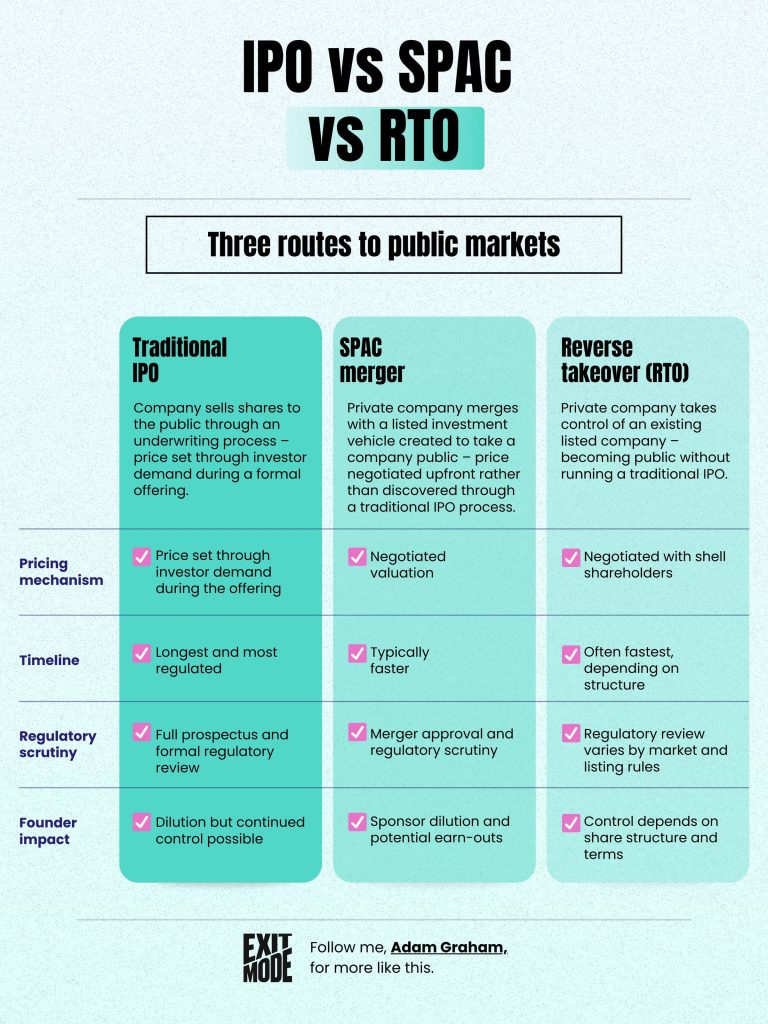
Public-market routes shape more than valuation
Founders tend to talk about going public as if it were one decision, when in reality the route you take can affect speed, scrutiny, leverage and how much control you keep once the deal is done. That matters because it shapes what life looks like on the other side. Worth considering if you want a cleaner sense of the trade-offs before any banker starts telling you there is only one sensible option.
Drop me a line
That’s a wrap for this week. The best part of putting this together is hearing where other people disagree, expand on it or pull it in a better direction, so do reply if there’s something here you’d like to discuss.
Cheers!
Adam
Unsubscribe · LinkedIn