The search box is losing its grip
Hi there
I have been turning one idea over all week, and it is this: the places that decide your future are moving. Where customers find you, where buyers judge you, where the next generation chooses to work. None of it sits where it did three years ago. I will start with something of my own that brought this home, then follow the thread through the rest of this issue.
Enjoy!
My own company just stepped inside the tools people already use
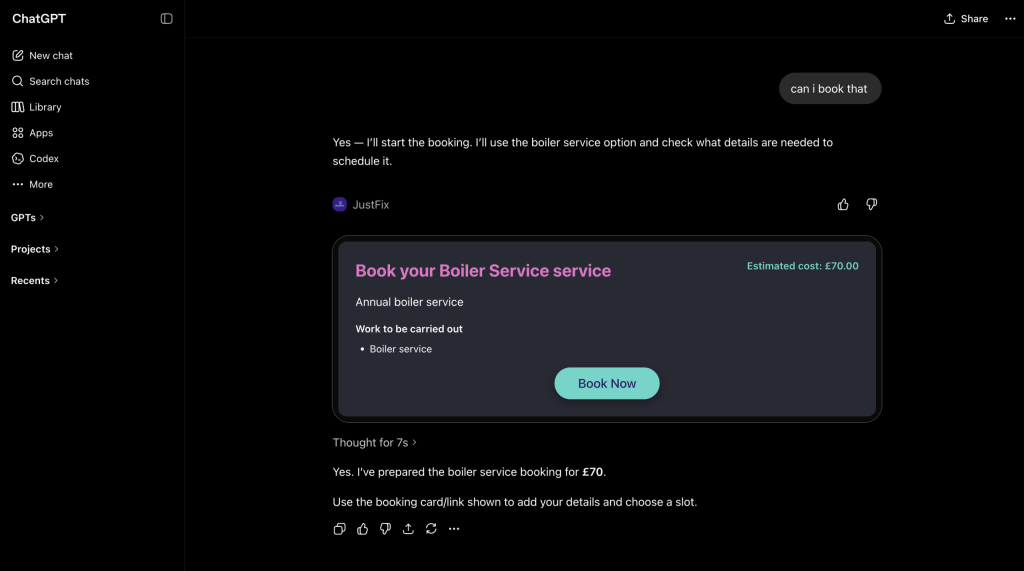
I usually point you at other people’s deals in here. This week, indulge me with one of mine. JustFix, the UK home-services business I run, has put itself inside the AI assistants people already open every day. You can now ask ChatGPT what it costs to fix a dripping tap, get a real itemised quote, and book a vetted tradesperson without leaving the chat. Underneath sits a public MCP server, the open standard that lets any assistant plug into a live service, plus open-source skills for the main agent frameworks. The point is not the technology. It is the lesson the rest of this issue keeps circling: the way customers find you is shifting from the search box to the assistant, and the businesses that turn up there early will hold that ground while everyone else is still optimising for Google. Read about how we did it here.
The shop window is moving from the results page to the conversation
This is the wider shift behind my own story. Search Engine Land argues that product discovery is moving from a list of blue links to a conversation, where the assistant recommends and the customer rarely sees ten options at all. Their study flags “recommend products” as the single task people most trust AI to handle. The implication for founders is uncomfortable but clear: ranking on page one matters less than being the thing an assistant names when someone asks what to buy. That is a different discipline, built on structured information and credibility rather than keywords. Worth reading if you sell anything a customer might one day ask a chatbot about. Read the article here.
Being recommended by AI is the start of the sale, not the end of it
Before anyone declares search dead, here is the useful counterweight. A new survey from Idea Grove found that only 2 per cent of consumers will buy a brand an AI recommends without checking it themselves first. The rest go and look: reviews, press coverage, a credible website, search results. In other words, the assistant has become the new front door, but the old trust signals still decide whether people walk through it. That is reassuring for anyone who has spent years building reputation the slow way. The assistant points; your credibility closes. Both halves matter, and neglecting either leaves money on the table. Find out more here.
Buffett’s successor announces himself with a chequebook
Berkshire Hathaway agreed to buy the American homebuilder Taylor Morrison for around 6.8 billion dollars, and what makes it notable is the signature on the deal. This is Greg Abel’s first major acquisition since taking over as chief executive, with Buffett publicly crediting him for the work. New leaders inherit a company, but they define themselves by their first real decision under their own name. Abel chose a cyclical, unglamorous, cash-generative business just as others turn nervous about housing, which is about as Berkshire a move as a successor could make. The lesson holds for any handover, founder or otherwise: the first deal you own outright tells people what kind of operator you intend to be. Read the story here.
Gen Z is answering a closing door by building its own room
The Guardian ran a long piece on what it calls “Generation Entrepreneur”: young workers responding to a shrinking pool of entry-level jobs by starting their own businesses instead. The same AI that is thinning out junior roles is also lowering the cost of going it alone, covering skills they do not yet have and letting one person do the work of several. I take an optimistic view of this. A cohort that learns to build something from nothing in its early twenties, out of necessity rather than ambition, is going to be a formidable generation of operators and, eventually, of sellers. The ladder is being pulled up, so they are constructing their own. Read it here.
Automating the bottom rung might cost you the top one
The flip side came from MIT’s Andrew McAfee, writing in Fortune. His warning to leaders is blunt: automate away your entry-level jobs and you dismantle the pipeline that produces your future senior people. Companies cheering this quarter’s efficiency gains may be deciding, without realising it, that they will have no experienced managers to promote in a decade. The cheapest roles to cut are often the ones that train everyone else. For founders building lean, the question is not whether AI can do a junior’s tasks, but where tomorrow’s judgement will come from if no one is ever allowed to learn. Read the article here (paywalled, Archive).
Pricing power is the cleanest test of whether your brand is real
Marketing Week dug into the stubborn problem of linking brand equity to pricing power, the ability to raise prices without losing customers. It is one of those things everyone agrees matters and almost no one can put a number on. The piece is honest about how hard it is to quantify, but the underlying truth is worth holding onto: a brand that cannot charge a premium is, commercially, not much of a brand. With input costs climbing again, the firms that can lift prices and keep their customers are the ones with something genuinely defensible. If a competitor could match your price tomorrow and win, you have a product, not a brand. Read it here.
The biggest companies in private hands are finally heading for the door
Wall Street is bracing for the largest wave of mega-listings in its history. SpaceX confirmed a float expected around 12 June, targeting a valuation near 1.75 trillion dollars, which would be the biggest IPO ever, with OpenAI and Anthropic widely expected to follow. Analysts reckon the three together could be worth 4 to 5 trillion dollars once public. There is a founder lesson buried in the spectacle. Even the most celebrated private companies in the world eventually need liquidity, a public price, and a way for early backers to get paid. Exit is not a failure of ambition; it is the event every serious business is built towards, whether the number has nine zeros or four. Read the story here.
AI prompt of the week: how do you show up when someone asks an assistant?
Given where this issue started, here is a prompt to find out what an AI assistant actually says about your business when a customer asks. Most founders have never checked. Run this, then test the real thing in ChatGPT or your assistant of choice and compare.
Act as a prospective customer who has never heard of my business and is using an AI assistant to decide who to buy from. My business is [name], in [sector], based in [location], serving [customer type]. The kind of question a customer might ask is [example question, e.g. “who can fix a leaking radiator in Leeds”].
Walk me through, step by step, how an AI assistant is likely to answer that question today: what sources it would pull from, what signals it would weigh, and how likely it is to name a business like mine.
Then produce:
A blunt assessment of whether my business would currently be recommended, and why or why not.
The three most important things missing that would make an assistant confident enough to name me.
A prioritised, practical list of what to fix first, ranked by effort against impact, that a small team could actually do in the next quarter.
Base this on how AI assistants currently retrieve and rank information about businesses, not on generic marketing advice. Be specific and honest, even where the answer is uncomfortable.
JustFix app on ChatGPT
Here’s a screenshot of our app in ChatGPT. If you would like to try it, you can access it here.
Drop me a line
The best part of putting this together is hearing where you see it differently. If you have started turning up inside AI answers, or deliberately stayed out of them, I would genuinely like to know how it is going. Reply and tell me; I read every one, and the conversations that come back are often the highlight of my week.
Cheers!
Adam