What gets you on (or off) the AI search shortlist
Welcome to The Growth Mindset. I’m sharing a few stories that landed differently this week, from how buyers now build supplier shortlists to what agencies get wrong about outreach. Essentially, the kind of details that stuck with me after I’d closed the tab – and that I think might spark something for you too.
Enjoy!
How AI is reshaping the signals B2B buyers trust
Davang Shah, LinkedIn’s VP of marketing, has an interesting take on what AI may be changing in B2B marketing. His argument is that as tools such as ChatGPT, Copilot and Gemini play a bigger role in how buyers research markets and shape early shortlists, visibility alone starts to lose some of its power. In its place comes something harder to manufacture: credibility. That includes trusted mentions, expert voices, peer signals and the kind of third-party context that makes a brand feel safer to put forward internally. Some of the language in his piece is a bit conference-stage for my taste, but the core point is worth paying attention to – especially for founders who still think the job is simply to get seen. Read it here.
Why social search is becoming part of the B2B buying journey
A new Sprout Social article makes the case that B2B buyers are no longer doing all their early research through LLMs or Google alone. They are also searching LinkedIn, YouTube, Reddit and niche communities to compare suppliers, sense-check claims and work out which brands feel credible before they ever reach a website. Ultimately, the take-out is that discovery is becoming more scattered, more social and more trust-led, especially in markets where buyers want evidence from people as much as information from brands. Find out more here.
Amusingly, even Snapchat wants a bit of the B2B sales pie. Check out its claims to be a growth lever for business here.
How agency outreach can fail before it starts
Ian Fitzpatrick, who leads global Running and Sport marketing at New Balance, has shared a useful client-side view on how agencies should approach brands. His point is not that outreach is unwelcome. It’s that most of it is careless. Agencies should write a proper email from scratch, explain why there is a real fit, stop leaning on flattery, and resist sending speculative creative that is not grounded in the brand’s actual commercial challenge. He also advises patience: serious brands can take time to respond, and pestering people is more likely to damage your chances than improve them. Worth reading for agencies, but also for anyone selling expertise – because the way you introduce your business says a lot about how you are likely to do the work. Read his advice here.
Spring 2026 is more cosy than aspirational, says Pinterest
Pinterest’s latest Spring Trend Report is an interesting snapshot of a mood shift that feels bigger than its featured interiors, recipes or cleaning hacks. The findings are that people are moving away from reinvention and towards smaller, more manageable forms of self-expression: micro-makeovers instead of dream-home fantasies, comforting food instead of self-denial, balcony gardens instead of big escapes, and cleaning framed as reset rather than punishment. Some of the search trends are a bit flimsy in isolation, as social reports often are, but taken together they point to something real: consumers seem to want lives that feel warmer, more personal and more doable, not perfectly optimised. Read the report here.
Can Gap make its comeback stick?
The Economist recently looked at Gap’s attempt to rebuild itself under Richard Dickson, the former Mattel executive now borrowing some of the Barbie playbook for a brand that had drifted into irrelevance. The interesting question is whether more engaging storytelling, better product, faster production and a cleaner retail experience can turn a run of improved results into something more durable. The signs are encouraging – same-store sales are up, the brand looks more focused, and shoppers seem willing to pay a bit more – but the piece is clear that the revival is still unfinished, and that its push into “fashiontainment” remains an open question. Find out more here. (Paywalled but use Archive to access.)
Why AI may make startups easier to launch and harder to build
Antler has published a smart piece on one of the stranger founder paradoxes of 2026: AI has made it much easier to get a product off the ground, but much harder to build a durable business around it. The argument is that barriers to entry are falling fast, while the real points of friction are shifting elsewhere – distribution, pricing, trust, execution and the uncomfortable fact that bigger companies can now move much faster too. It is a VC-backed view, so not exactly disinterested, but the core point is a good one: building something is getting cheaper, while building something defensible may be getting harder. Find out more here.
Thinking about your first NED role? Start here
Breaking into the boardroom can feel opaque, especially for first-time and aspiring non-executive directors. A masterclass from C-suite recruitment specialists Warren Partners on Monday 27 April is designed to make the process clearer and more practical, with expert advice on how to position yourself for a NED role, engage effectively with headhunters, strengthen your CV and prepare properly for interview. If a portfolio career is on your radar – or you simply want a better understanding of what the path looks like – this could be a useful place to start. Register now to secure your place.
Another big Web3 gamble meets reality
A week after this newsletter noted the metaverse’s retreat, El País delivers another useful reality check on Web3. This time the focus is NFTs – a market once sold as a new frontier for art and ownership, but which now looks, for many buyers, more like speculation in fancy dress. Put next to the metaverse story, it feels like the same pattern again: big promises, weak real-world use and a lot of money lost on the way down – not least for Justin Bieber, who spent £1.3mn on a cartoon picture of an ape. Read the story here.
What 81,000 AI users say they want from the future
Anthropic has published a substantial piece of research based on more than 80,000 interviews with Claude users across 159 countries and 70 languages, and the most interesting takeaway is how un-futuristic many of the answers are. People are not mainly asking AI for magic. They just want help doing better work, thinking more clearly, managing life, and getting some time and headspace back. The study is not neutral – it is based on existing Claude users who opted in, so it naturally skews towards people already finding value in AI – but it is still one of the more useful attempts to get beyond the usual hype and ask what people hope this technology will do for them. Read the study here.
AI prompt of the week: your investor update template
Founders know they should keep investors close, but many updates are rushed, irregular or written only when things are going well. A simple, consistent format does more than keep people informed – it builds trust, surfaces help when you need it and forces you to look your own numbers in the eye every month.
Help me design a high-quality monthly investor update template.
My context: [stage], [sector], [business model], [number of investors], [current reporting habits], [top 3 metrics we track].
Create:
- A clear structure for a one-page monthly update (sections for metrics, highlights, lowlights, product, team, market).
- A shortlist of core metrics to include (revenue/MRR or GMV, burn, runway, growth and retention) with guidance on how to present trends, not just snapshots.
- Simple wording examples for highlights and lowlights that are honest without being alarmist or overly promotional.
- A focused asks/support section that makes it easy for investors to help (introductions, hiring, customer leads, specific expertise).
- Optional variants for quarterly board-style updates vs shorter “heartbeat” emails during a raise.
Base this on best practices from early-stage startups that send consistent, high-quality updates and use them to deepen relationships well before they need to raise again.
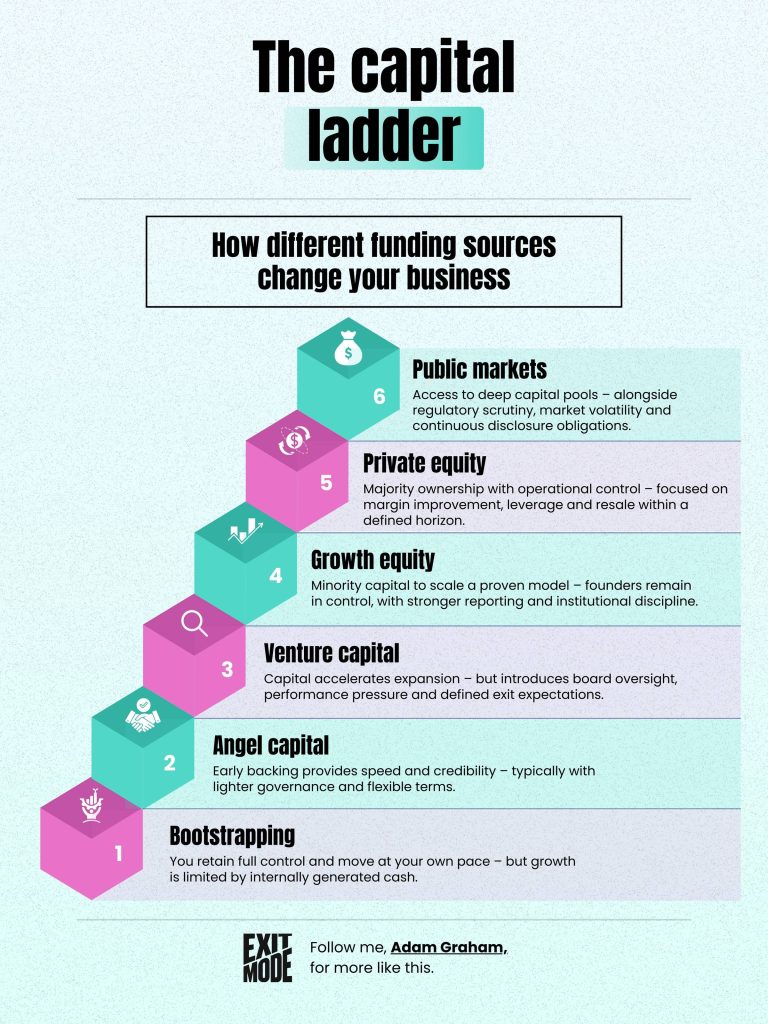
The funding you choose rewires the business you build
Founders often talk about capital as fuel, but it is more like architecture. Each source of money brings its own pace, pressure and trade-offs – shaping how decisions get made, how quickly you grow and how much control you keep. The money may help you scale, but it also starts to define the company.
Drop me a line
Readers occasionally hit reply with a story from their corner of the world that flips how I see trends or business development – those notes always make my week. If anything here jogged a memory or a current challenge, send it over. I read every one. See you next Sunday.
Cheers!
Adam
Unsubscribe · LinkedIn